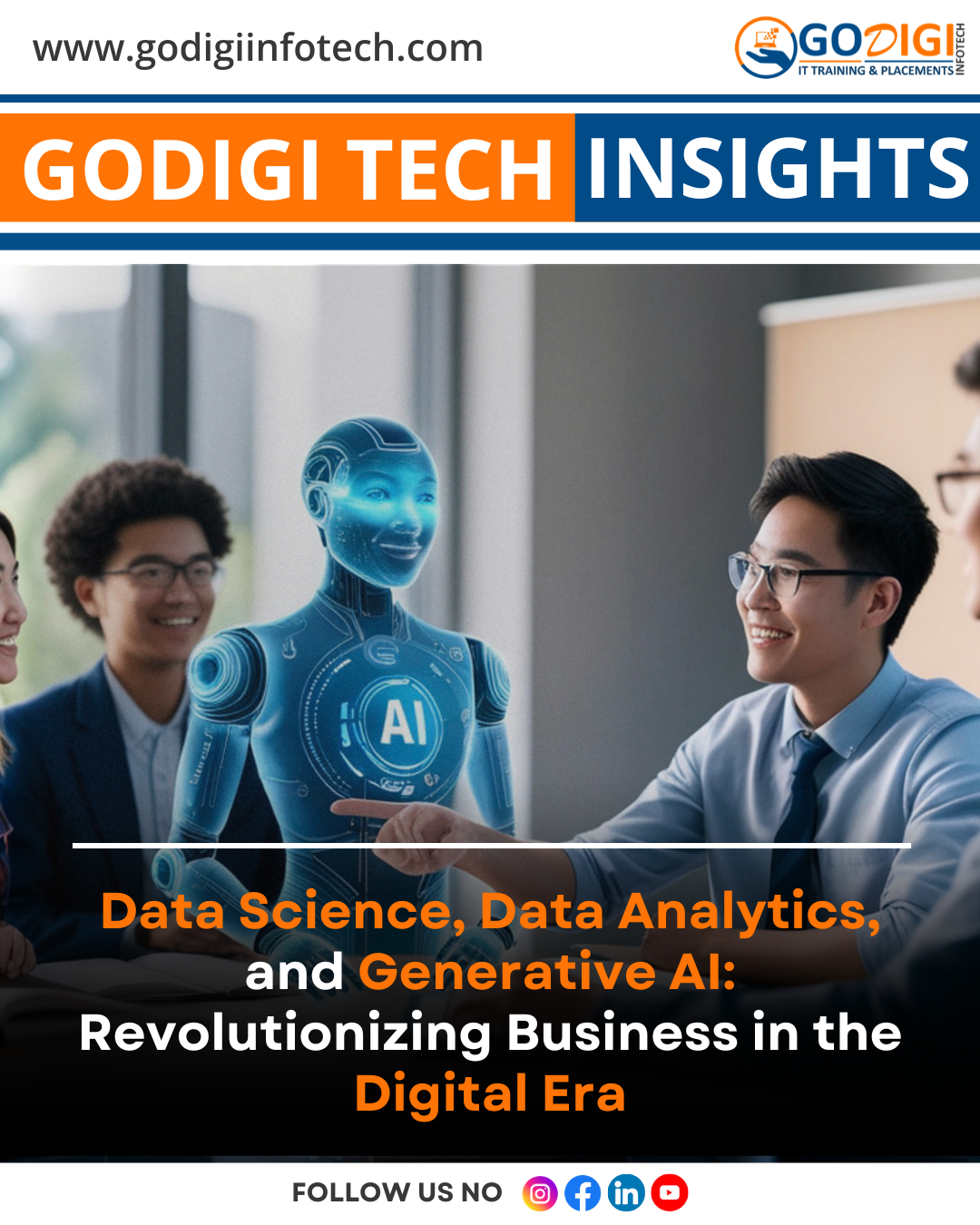
Data Science, Data Analytics, and Generative AI: Transforming Businesses in the Digital Age
Data Science, Data Analytics, and Generative AI: Revolutionizing Business in the Digital Era
Introduction
In the era of digital transformation, businesses are inundated with enormous volumes of data. Extracting actionable insights from this data has become essential for staying competitive. Data Science and Data Analytics have emerged as powerful tools to decode complex datasets, while Generative AI is revolutionizing content creation, automation, and predictive decision-making. Companies like GoDigiInfotech are at the forefront of integrating these technologies to empower organizations across industries.
This blog will explore the significance of Data Science, Data Analytics, and Generative AI, their applications, and how businesses can leverage these technologies to drive growth, efficiency, and innovation.
What is Data Science?
Data Science is the interdisciplinary field that combines statistics, computer science, and domain expertise to extract knowledge and insights from structured and unstructured data. It involves collecting, processing, analyzing, and interpreting data to make informed business decisions.
Key components of Data Science include:
- Data Collection & Cleaning: Gathering data from multiple sources and ensuring accuracy.
- Data Modeling & Analysis: Applying statistical models and algorithms to identify patterns.
- Machine Learning: Creating predictive models to forecast trends or behavior.
- Visualization & Reporting: Presenting insights through dashboards, charts, and interactive reports.
The growing adoption of cloud computing, IoT devices, and social media has accelerated the importance of Data Science. According to a report by Gartner, organizations that invest in Data Science projects experience a 20-30% improvement in operational efficiency.
Understanding Data Analytics
While Data Science focuses on extracting knowledge from data, Data Analytics is primarily concerned with interpreting data to inform decisions. It’s the process of examining datasets to identify trends, draw conclusions, and solve specific business problems.
Data Analytics can be categorized into four types:
- Descriptive Analytics: What happened? Example: Monthly sales reports.
- Diagnostic Analytics: Why did it happen? Example: Customer churn analysis.
- Predictive Analytics: What is likely to happen? Example: Forecasting demand trends.
- Prescriptive Analytics: What actions should be taken? Example: Recommendations for marketing campaigns.
By leveraging Data Analytics, organizations can optimize operations, reduce costs, enhance customer experience, and drive revenue growth. For instance, e-commerce companies analyze purchasing data to personalize recommendations, while healthcare providers use analytics to predict disease outbreaks.
The Rise of Generative AI
Generative AI refers to AI models that can generate new content based on learned patterns from existing data. Unlike traditional AI, which focuses on analyzing or classifying data, generative AI creates novel outputs, such as text, images, videos, music, and even code.
Popular examples of generative AI include:
- Chatbots & AI Writing Tools: For automated content creation and customer support.
- Image & Video Generation: AI-powered tools for marketing campaigns and creative design.
- Code Generation: AI assistants that accelerate software development.
Generative AI leverages technologies like Large Language Models (LLMs), Generative Adversarial Networks (GANs), and transformer architectures to produce realistic outputs. Businesses across industries are adopting generative AI to reduce manual work, enhance creativity, and personalize user experiences.
How Data Science and Analytics Complement Generative AI
Generative AI does not exist in isolation. It relies heavily on robust Data Science and Analytics frameworks to ensure accuracy, relevance, and efficiency. Here’s how they complement each other:
- Data-Driven Training: Generative AI models require high-quality datasets to learn patterns effectively. Data Science ensures proper data collection, cleaning, and preprocessing.
- Insightful Feedback Loops: Analytics provides continuous monitoring and evaluation of AI outputs, improving model performance over time.
- Predictive Enhancement: Predictive analytics informs generative AI models about potential user needs or market trends, enabling personalized content generation.
- Business Integration: By combining analytics and AI, companies can automate decision-making processes, from customer engagement to supply chain optimization.
For instance, a marketing agency can use data analytics to understand audience preferences and then employ generative AI to create targeted ad campaigns tailored to each segment.
Real-World Applications
1. Healthcare
- Predictive analytics helps forecast patient readmissions.
- Generative AI assists in creating synthetic medical images for training purposes.
- Data Science models identify disease patterns and optimize treatment plans.
2. E-commerce & Retail
- Personalized recommendations based on customer behavior data.
- Automated content generation for product descriptions.
- Inventory optimization using predictive analytics.
3. Finance
- Fraud detection through machine learning algorithms.
- AI-generated reports for investment analysis.
- Predictive risk assessment and portfolio optimization.
4. Media & Entertainment
- AI-generated scripts, music, and visual effects.
- Audience engagement analysis using Data Analytics.
- Real-time content personalization for streaming platforms.
Benefits of Implementing Data Science, Analytics, and Generative AI
- Enhanced Decision-Making: Data-driven insights minimize errors and guide strategic planning.
- Operational Efficiency: Automation reduces manual effort and accelerates workflows.
- Cost Reduction: Predictive models and AI automation cut unnecessary expenditures.
- Innovation & Creativity: Generative AI enables new forms of content creation and product development.
- Customer-Centric Strategies: Analytics helps personalize offerings, improving engagement and loyalty.
Challenges and Considerations
While the benefits are substantial, organizations must be aware of potential challenges:
- Data Privacy: Ensuring compliance with GDPR, HIPAA, and other regulations.
- Model Bias: AI models can inherit biases present in training datasets.
- Resource Investment: Implementing AI and analytics solutions requires skilled professionals and infrastructure.
- Interpretability: Understanding AI decisions can be complex and requires transparent reporting.
A balanced approach that combines advanced technology with ethical practices ensures long-term success.
Future Trends in Data Science, Analytics, and Generative AI
- Hyper-Personalization: AI models will deliver highly tailored user experiences.
- Real-Time Analytics: Faster decision-making through streaming data analytics.
- AI-Driven Automation: Generative AI will automate complex business tasks, from marketing to product design.
- Cross-Industry AI Applications: Increasing adoption in healthcare, finance, logistics, and education.
- Ethical AI: Greater emphasis on transparent, explainable, and unbiased AI models.
According to a report by McKinsey, companies adopting AI and analytics effectively could generate an additional $13 trillion in global economic value by 2030.
How GoDigiInfotech Can Help
At GoDigiInfotech, we specialize in providing end-to-end solutions for Data Science, Data Analytics, and Generative AI. Our services include:
- Data Strategy & Consultation: Tailored strategies to leverage data for business growth.
- Predictive & Prescriptive Analytics: Models that anticipate trends and optimize decisions.
- AI & Machine Learning Solutions: Deploying generative AI for content, automation, and insights.
- Visualization & Reporting: Interactive dashboards and real-time reporting for actionable insights.
- Training & Support: Upskilling teams to adapt to AI-driven workflows.
Our experts ensure that your organization harnesses the full potential of emerging technologies, transforming data into a powerful competitive advantage.
Conclusion
The convergence of Data Science, Data Analytics, and Generative AI is redefining the way businesses operate. Organizations that embrace these technologies gain a strategic edge through enhanced decision-making, operational efficiency, and innovation.
As AI continues to evolve, businesses must invest in data-driven approaches while maintaining ethical standards and transparency. GoDigiInfotech is committed to guiding organizations through this digital transformation, enabling them to unlock the true value of data and AI.
Embracing these technologies today ensures that your business is prepared for the competitive landscape of tomorrow.